
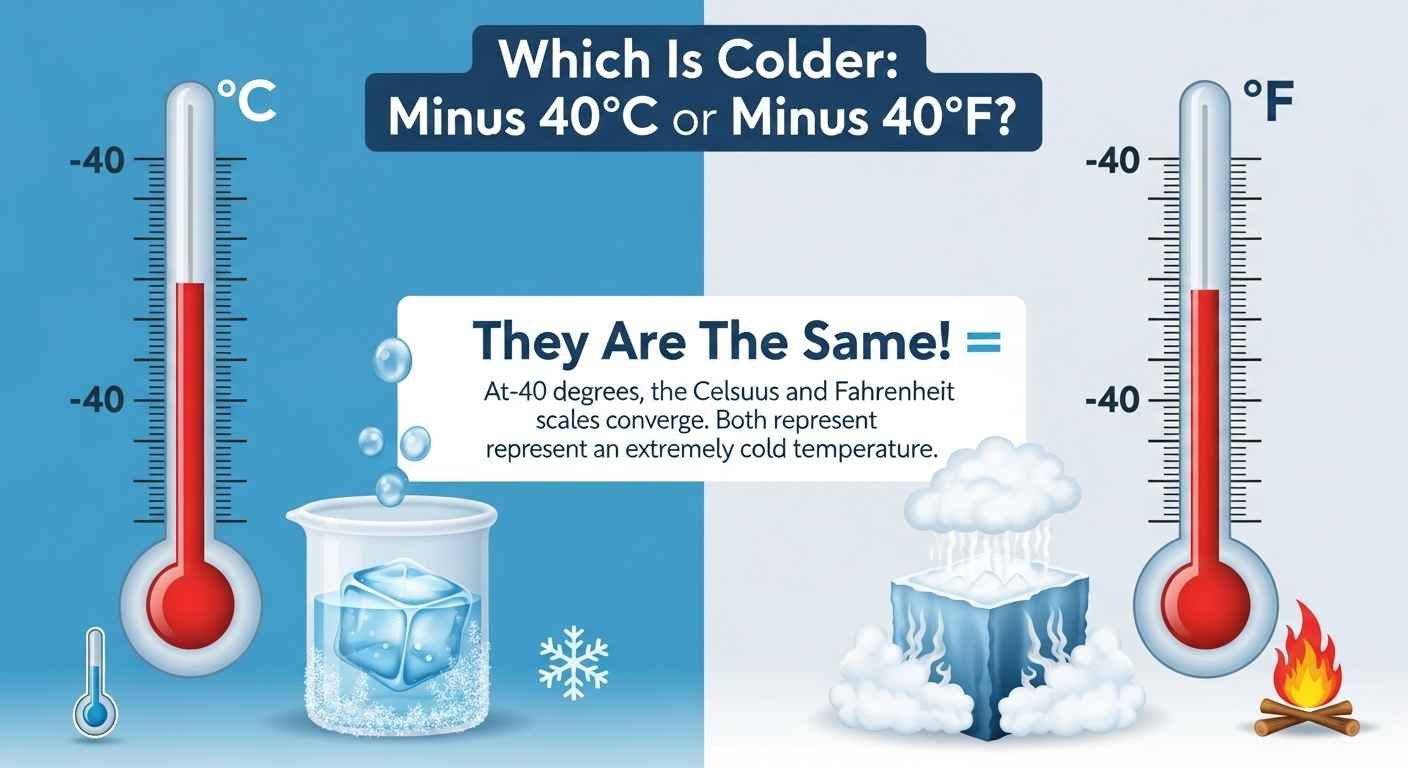
Many people ask the question which is colder: minus 40°c or minus 40°f? at some point, and the answer may surprise you. At first glance, the numbers look different, and because Celsius and Fahrenheit are separate temperature scales, it can seem confusing. However, physics and simple math give us a clear answer: −40°C is equal to −40°F.
This article explores the science behind the question which is colder: minus 40°c or minus 40°f?, explains how temperature scales work, and shows why this is the only point where Celsius and Fahrenheit match numerically.
Understanding Celsius and Fahrenheit
Before answering which is colder: minus 40°c or minus 40°f?, it is important to know how the scales work.
Celsius (°C) is based on water:
-
0°C is the freezing point of water
-
100°C is the boiling point of water
Fahrenheit (°F) has different reference points:
-
32°F is the freezing point of water
-
212°F is the boiling point of water
Because the scales start at different points and use different increments, a direct numeric comparison can be misleading. That’s why many people ask which is colder: minus 40°c or minus 40°f?.
The Conversion Formulas
To compare Celsius and Fahrenheit, we use standard conversion formulas:
Celsius to Fahrenheit:
°F=(°C×9/5)+32°F = (°C × 9/5) + 32
Fahrenheit to Celsius:
°C=(°F−32)×5/9°C = (°F − 32) × 5/9
Plugging in −40°C:
°F=(−40×9/5)+32=−72+32=−40°F = (-40 × 9/5) + 32 = -72 + 32 = -40
So −40°C converts exactly to −40°F. This shows why the question which is colder: minus 40°c or minus 40°f? is answered with they are the same temperature.
Why Does This Happen?
Celsius and Fahrenheit are linear scales, meaning both increase and decrease proportionally but with different starting points and step sizes.
Graphing the two scales, you see their lines intersect at exactly one point — −40°. Above this, Fahrenheit numbers are numerically higher than Celsius. Below this, Fahrenheit numbers are numerically lower.
Thus, −40° is unique. It is the only temperature where Celsius and Fahrenheit match.
Extreme Cold: What −40 Means
When considering which is colder: minus 40°c or minus 40°f?, both temperatures are extremely cold. At −40°:
-
Exposed skin can freeze within minutes
-
Breathing cold air can feel painful
-
Metals and plastics become brittle
-
Car engines and batteries may fail to work efficiently
This temperature occurs naturally in some of the coldest inhabited places on Earth, like Siberia, northern Canada, and Alaska.
Human Experience and Safety at −40°
At −40°, precautions are necessary:
-
Dress in multiple layers, with insulated outerwear
-
Protect hands, feet, and face from frostbite
-
Limit outdoor exposure time
-
Be cautious of wind chill, which can make it feel even colder
Understanding which is colder: minus 40°c or minus 40°f? is more than a math exercise—it’s important for safety in extreme climates.
The Kelvin Perspective
In Kelvin, −40°C equals 233.15 K, which is still far above absolute zero (0 K) but represents severe frost. While Fahrenheit and Celsius scales are human-centered, Kelvin provides an absolute scale for scientific understanding.
Practical Implications of −40°
Knowing which is colder: minus 40°c or minus 40°f? matters in various fields:
-
Science & Education: It demonstrates linear equations and scale conversions
-
Engineering: Cold-weather testing of vehicles, machinery, and electronics
-
Daily Life: International travelers must interpret weather reports accurately
Summary Table
| Temperature Reading | Equivalent Temperature | Coldness Level |
|---|---|---|
| −40 °C | −40 °F | Extremely cold |
| −40 °F | −40 °C | Extremely cold |
| Answer to Main Question | – | Both are the same |
So when someone asks which is colder: minus 40°c or minus 40°f?, the correct answer is neither — they are equal in coldness.
Conclusion
The question which is colder: minus 40°c or minus 40°f? is a great example of how science and mathematics intersect in the real world. While the two scales appear different, at −40° they are identical. Whether you are learning about temperature conversions, planning for extreme weather, or just curious, knowing this fact helps you understand the world a little better.




Leave a Reply