
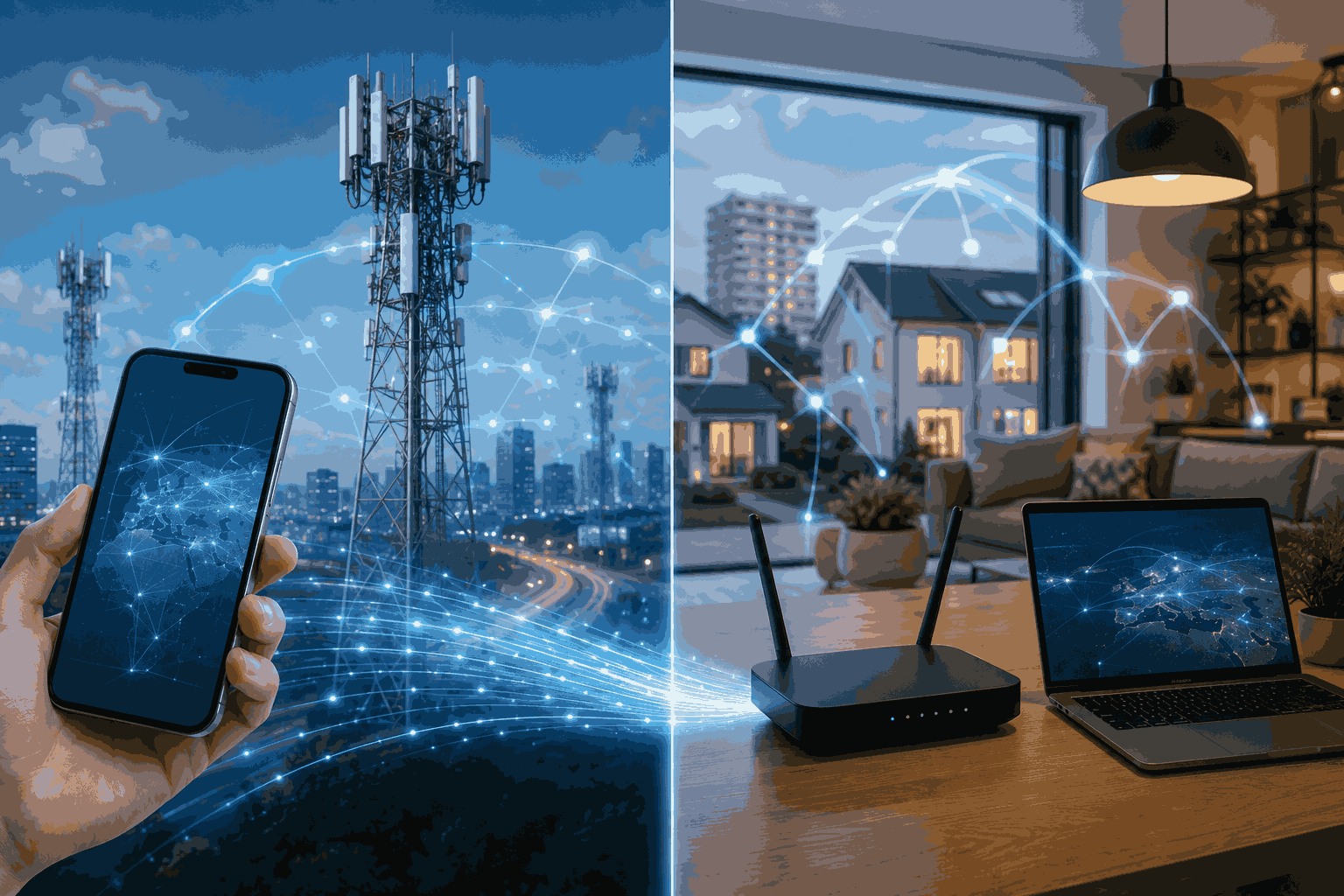
Mobile proxies and residential proxies are the two most trusted proxy types, and choosing between them is one of the most common questions for anyone doing web scraping, ad verification, or multi-account work. They look similar on the surface, since both route your traffic through real consumer connections, but they behave very differently against modern detection systems. This guide breaks down how they compare in 2026 and which one is the better choice for your use case.
The Short Answer
If you need the highest trust and the fewest blocks on strict, well-defended sites, mobile proxies win. If you need broad coverage and high volume at a lower price for lighter tasks, residential proxies are the more economical option. Neither is universally “better.” The right pick depends on how hard your target is and how much you are willing to spend.
What Is the Difference?
The difference comes down to where the IP address originates.
- Residential proxies use IP addresses assigned to real homes by internet service providers. To a website, the traffic looks like a person browsing from their house.
- Mobile proxies use IP addresses assigned by mobile carriers to phones and tablets on 4G and 5G networks. The traffic looks like a person browsing on their phone.
Both are genuine consumer IPs, which is why both pass checks that instantly flag datacenter proxies. The gap between them shows up in how detection systems treat each type.
Head-to-Head Comparison
| Factor | Residential proxies | Mobile proxies |
|---|---|---|
| IP trust and block resistance | High | Highest |
| Reputation risk | Shared pools can carry prior abuse | Very low, IPs are shared with real users |
| Geo-accuracy | Good, ISP registration level | Excellent, carrier and tower level |
| Speed | Generally fast | Depends on signal, usually strong on 5G |
| Cost | Lower per GB | Higher per GB |
| Pool size | Very large | Smaller but higher quality |
| Best for | High-volume, broad tasks | Strict targets and sensitive tasks |
Trust and Block Resistance
This is where mobile proxies pull ahead. Mobile networks use carrier-grade NAT (CGNAT), which means many real subscribers share the same public IP address at the same time. Cloudflare has explained that this makes those addresses risky to block, because cutting one off would cut off large numbers of genuine customers (Cloudflare).
Residential IPs do not have that shield. Each home IP is tied to one household, so a site can block a single residential address without much collateral damage. That makes residential proxies easier to flag than mobile ones, especially on platforms with aggressive anti-bot systems.
Reputation and Freshness
Residential proxies are usually sold from large shared pools, and those pools recycle IPs across many users. If someone before you abused an IP on a particular site, you can inherit that bad reputation before you send a single request. Quality varies a lot between providers, and freshness is hard to guarantee.
Mobile IPs are also shared, but they are shared with ordinary mobile users going about their day, and they rotate naturally as devices move between cell towers. That constant churn of legitimate activity keeps their reputation clean, which is a real advantage on sites that score IP history.
Speed and Stability
Residential proxies tend to be consistently fast, since home broadband is stable. Mobile proxies depend on signal strength, but on a good 4G or 5G connection they are more than fast enough for scraping, account management, and verification. For sticky sessions, both can hold an IP for a set period, though mobile providers often give you more control over how long a session stays put.
Cost
Cost is where residential proxies win. Because mobile proxies run on real cellular hardware and SIMs, they are more expensive per gigabyte than residential. Residential proxies are cheaper and come in enormous pools, which makes them attractive for high-volume jobs where the occasional block is acceptable. If your work is sensitive enough that a block is costly, the higher price of mobile usually pays for itself in reliability.
When to Use Residential Proxies
Residential proxies make sense when:
- You need to move high volumes of requests at the lowest cost.
- Your target sites have light or moderate anti-bot protection.
- Broad geographic coverage matters more than maximum trust.
- The occasional block is not a big deal for your workflow.
When to Use Mobile Proxies
Mobile proxies are the better choice when:
- You are working against strict, well-defended platforms.
- You manage multiple accounts and need each one to look like a separate real user.
- You need accurate, carrier-level geo-targeting.
- Getting blocked is expensive, so reliability is worth paying for.
For those cases, providers such as VoidMob run mobile proxies on genuine 4G and 5G carrier networks, with shared pools for volume and dedicated IPs for the hardest targets.
Which Is Better in 2026?
If forced to pick one word, mobile is the more capable proxy type, because it is the hardest to detect and block and it holds up on sites where residential struggles. But “better” really depends on the job. Residential proxies remain the smarter economic choice for large-scale, lower-risk tasks, while mobile proxies are the tool for sensitive, high-stakes work where trust and stability matter most.
Many experienced operators use both: residential for broad, cost-sensitive collection, and mobile for the accounts and targets they cannot afford to lose.
Frequently Asked Questions
Are mobile proxies better than residential proxies? For strict targets and sensitive tasks, yes, because mobile IPs are the hardest to block. For high-volume, lower-risk work, residential proxies are cheaper and often good enough.
Which is harder to detect, mobile or residential? Mobile. CGNAT means many real users share each mobile IP, so blocking one risks blocking real customers. That makes mobile IPs the hardest for detection systems to act against.
Are mobile proxies worth the higher cost? If a block costs you time, data, or a banned account, then yes. The higher reliability offsets the price. For casual or high-volume tasks where blocks are cheap, residential can be the better value.
Can I use residential proxies for managing multiple accounts? You can, but mobile proxies are the safer choice, since their higher trust and clean reputation reduce the risk of accounts being linked or flagged.
What is the main difference between mobile and residential proxies? Residential proxies use home ISP IPs, while mobile proxies use cellular carrier IPs. Both are real consumer connections, but mobile IPs are harder to block because of how mobile networks share addresses.
Final Thoughts
Mobile proxies and residential proxies are both far ahead of datacenter proxies, but they serve different jobs. Residential wins on price and scale, mobile wins on trust and block resistance. Match the tool to the task: pick residential for broad, budget-friendly work, and mobile for the strict sites and important accounts where staying undetected is worth the extra cost.





Leave a Reply